

The Metadata Problem
Thousands of African songs are generating real money on global platforms. A invisible technical failure means much of it never arrives.
Debutlab · Issue 08 · African Music & Tech
The song is on Spotify. It has been streamed over a million times. Fans in London, Toronto, and São Paulo have added it to their playlists. By any measure, it is working.
But the artist has not been paid for most of it.
Not because the platform stole the money. Not because a label took it. But because somewhere between the recording studio and the global royalty system, a piece of information went missing or was entered incorrectly — a code, a name, a split percentage — and now the revenue the song generated is sitting in a pool of unclaimed funds that nobody knows how to return.
This is the metadata problem. And in Africa, where music is going global faster than the administrative infrastructure can follow, it is costing artists an enormous, largely invisible amount of money.
30% of global royalties never reach creators due to missing data
$110M Sub-Saharan Africa recorded music revenue in 2024 — a record
~$1B+ estimated unclaimed royalties globally each year
The Black Box Has a Name
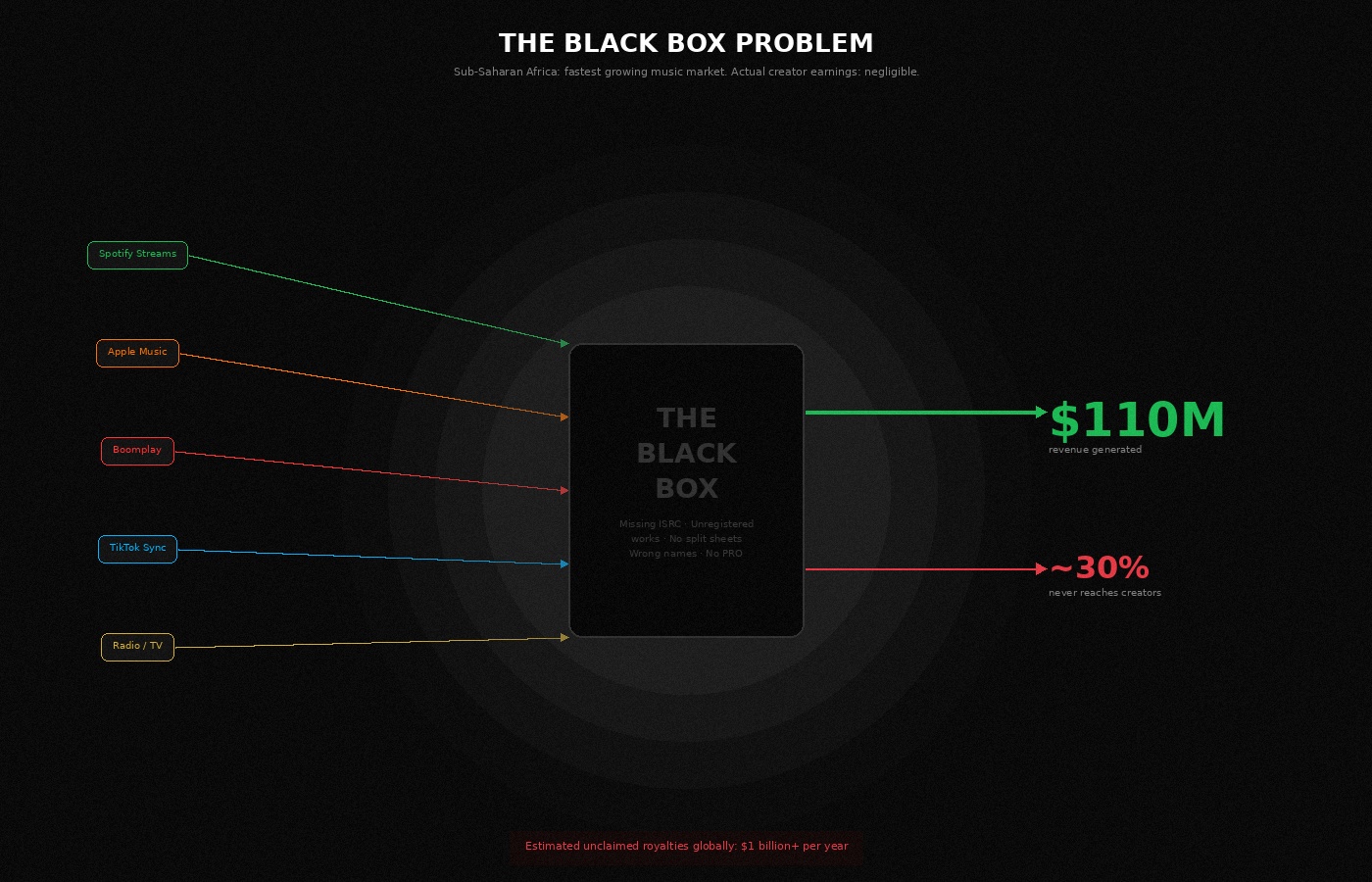
Industry insiders call it the Black Box. It is not a building or a company. It is a systemic gap — the space between the revenue African music generates globally and the amount that actually reaches the people who made it.
A 2025 report from Harvard University’s Centre for African Societies and Economies warned that Africa is capturing only a negligible percentage of the wealth its music creates.
Sub-Saharan Africa’s recorded music revenue crossed $110 million for the first time in 2024, growing at 22.6 percent — the fastest rate of any region in the world. Global recorded music revenues hit $29.6 billion that same year. Africa earned less than one percent of that total.
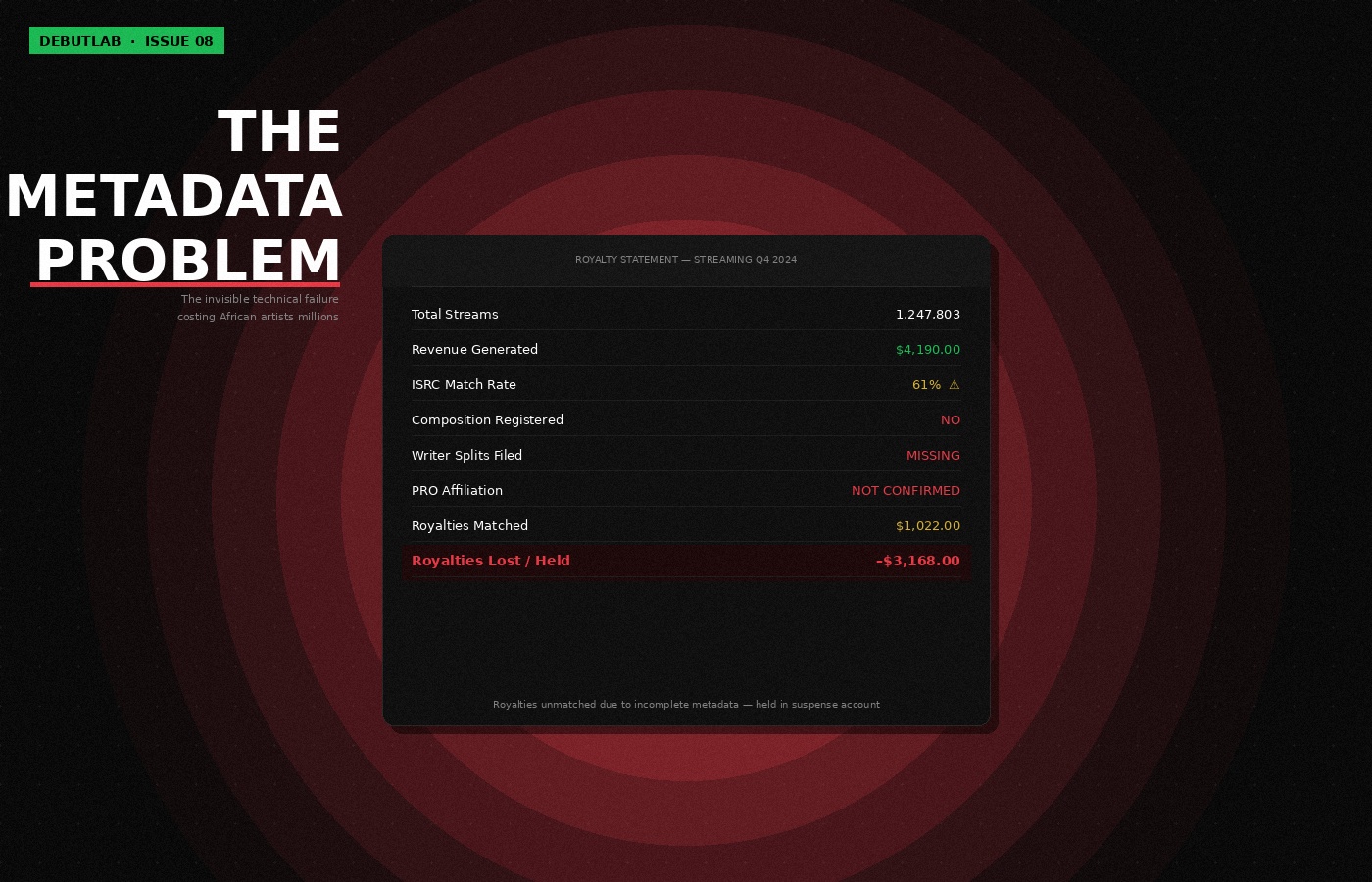
The gap is not entirely explained by streaming rates or subscription prices, though those are real factors. A significant portion of it is administrative. Rights that are not registered. Royalties that cannot be matched to a creator because the data is wrong, incomplete, or missing entirely. Money that sits in suspense accounts at collecting societies, waiting for a claim that never comes because the artist does not know the claim exists.
Around 30 percent of music royalties generated globally never make it to creators due to missing data and administrative failures. In Africa, where infrastructure is thinner and systems are underfunded, that percentage is believed to be even higher.
|
ISRC International Standard Recording Code. A unique identifier for each specific recording — not the song, the recording. Every version, every remix, every edit should have its own ISRC. |
|
ISWC International Standard Musical Work Code. Identifies the composition — the melody and lyrics — separately from any recording of it. |
|
IPI Interested Party Information number. Identifies a specific songwriter or publisher inside the global rights management ecosystem (CISAC). |
|
PRO Performing Rights Organisation. Bodies like COSON (Nigeria), SAMRO (South Africa), or MCSK (Kenya) that collect performance royalties on behalf of creators. |
|
CMO Collective Management Organisation. The broader category that includes PROs and neighbouring rights bodies. |
The five codes and identifiers every African artist needs to understand.
How the Money Gets Lost
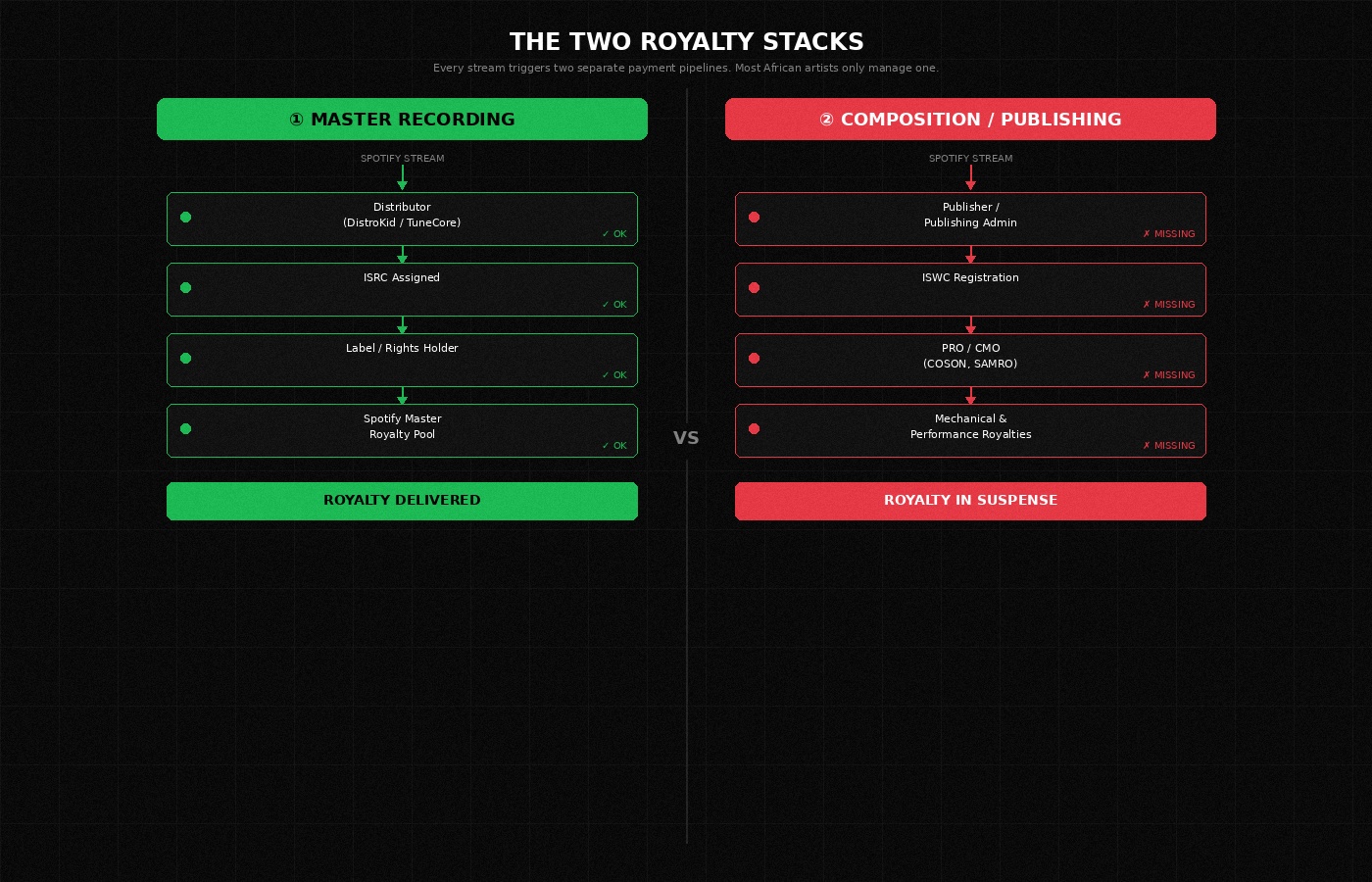
The path a royalty takes from a streaming platform to an artist’s bank account is far longer and more fragile than it appears. When someone in London streams a Nigerian song, Spotify splits the payment across two separate rights stacks: the master recording and the underlying composition. The master side flows through the distributor or label. The composition side flows through publishers, performing rights organisations, and collecting societies.
Each of those entities depends on accurate data to know where to send the money. If the ISRC attached to the recording does not match the ISWC registered for the composition, the systems
cannot connect them. If a songwriter’s name is spelled differently in two different databases — one system using ‘Adekunle Gold’, another using ‘Adekunle Kosoko’ — the royalty cannot be correctly attributed. If writer splits were never formally documented, the payment has nowhere to land.
The practical consequence is that royalties sit in what the industry calls suspense accounts or unmatched pools. The money is real. The claim is legitimate. But without clean data linking the usage to the rightsholder, it cannot be released. In South Africa, SAMRO has acknowledged that some royalties can take up to 12 months after broadcast to be distributed — and that timeline assumes the data is clean in the first place. When it is not, the wait can be indefinite.
AfroSoundtrack’s 2025 data illustrates the time dimension of this problem sharply: if a song released in early 2023 is not properly registered until 2026, most income from 2023 and 2024 is simply lost in markets outside North America. It either goes unclaimed or is redistributed to other rights holders. Most African artists do not know this. They often do not know what an ISRC code is, what neighbouring rights are, or that a performance royalty is owed every time their song plays in a restaurant.
The Specific Failures
Across African catalogues, the same pattern of failure appears with troubling consistency. Downtown Music Publishing Africa, which works with African rights holders across multiple territories, has documented the most common breakdown points.
The first is the split sheet gap. Many African recordings are made collaboratively — a producer in Lagos, a vocalist in Accra, a co-writer in London — but without a formal, signed document specifying who owns what percentage of the composition. When the money arrives, there is no agreed record to distribute it against. The royalty sits.
The second is role confusion. A distributor handling the master recording does not automatically handle the composition. These are separate rights with separate collection pathways. Artists who upload their music through DistroKid or TuneCore have solved the distribution problem. They have not necessarily solved the publishing problem. The recording is live and earning. The composition may be entirely unregistered.
The third is identifier mismatch. ISRCs, ISWCs, and IPI numbers need to connect cleanly across multiple databases for royalties to flow. African catalogues that travel quickly — radio, clubs, TikTok, diaspora playlists, brand placements — often accumulate usage data before the admin infrastructure is in place to capture it. By the time the paperwork is correct, the usage has already happened and the window for claiming some of that income has closed.
The fourth is language and spelling inconsistency. African artist names and song titles often appear differently across systems — different transliterations, different scripts, nicknames versus legal names. A royalty attributed to ‘Wizkid’ in one database and ‘Ayodeji Ibrahim Balogun’ in another cannot be automatically matched without human intervention. At scale, across thousands of songs and dozens of territories, this becomes an enormous administrative burden.
— D’Banj, Nigerian artist and founder of the Cream Platform
The Platforms Are Not Going to Fix It
Spotify paid roughly $59 million in royalties to artists in Nigeria and South Africa in 2024 — a record. The headline moved fast across African music media. What the headline did not explain is that the figure describes royalties attributed on the platform before they travel through deals, splits, collecting societies, admin fees, and recoupment timelines. The number that actually reaches individual creators, after all of those deductions and delays, is significantly different.
The platforms are not deliberately withholding money. They are paying into a system. What happens inside that system — whether the data is clean enough for the money to reach its destination, whether the collecting societies are functioning, whether the artist has registered their work — is largely outside their control and responsibility.
In Kenya, the Kenya Copyright Board denied MCSK, the music collecting society, an operating license for 2025-2026 after the organisation failed to submit audited financial statements. The artists whose royalties MCSK was supposed to collect and distribute had no recourse. The money generated by their music in Kenya and internationally, routed through MCSK, was effectively frozen.
This is the structural reality behind the streaming numbers. The platforms generate the revenue. The infrastructure — metadata standards, collecting societies, publisher registration systems, artist education — determines how much of it arrives.
What Getting It Right Looks Like
The solutions exist. They are not glamorous. They are administrative.
“African music is a global business now, but the business still isn’t African enough. Too many of the artists building this movement still don’t see the revenue their work generates.”
The most important shift is treating metadata as part of the creative process, not an afterthought. Downtown Music Publishing Africa describes this as tightening metadata at source — getting the ISRC, ISWC, writer credits, IPI numbers, and split percentages correct at the moment of creation and pre-release, before the song goes anywhere. Every correction made after the fact is slower, more expensive, and less likely to recover income that has already been generated.
The second shift is understanding the two-stack problem. Master rights and publishing rights are separate. Distributing a song through a digital aggregator solves the master side. Registering the composition with a publisher or publishing administrator, getting the ISWC assigned, and affiliating with a PRO solves the publishing side. Both need to happen. Many African artists do only one.
The third shift is timing. Registration before release is not bureaucracy for its own sake — it determines whether income generated in the first weeks and months of a song’s life can be captured at all. A song that blows up without its composition registered is generating money that may never be recovered.
New infrastructure is beginning to address the gap at scale. SyncAll, launched in 2025, aggregates rights-cleared African catalogues, enriches them with cultural metadata, and connects them to global sync buyers. Dajahtunes has built tools specifically designed to improve rights administration through technology, helping unlock what the company calls hidden money — performance royalties, mechanical royalties, and micro-sync royalties from platforms including TikTok. AfroSoundtrack operates as a publishing and royalty administration service built specifically for African creators, handling registration, metadata, and global collection.
These platforms cannot fix the problem retroactively for catalogues that were released without clean data. But they represent the beginning of an infrastructure layer that matches the global reach African music has already achieved.
The Invisible Invoice
There is a version of the African music boom story that ends with the streaming numbers: the billions of plays, the record revenues, the global chart positions. That story is real. The music is genuinely travelling.
But there is another story running alongside it, quieter and more costly. It is the story of the royalty that was generated and never claimed. The performance that was tracked and never matched. The split that was assumed and never documented. The registration that was meant to happen and did not.
It does not show up in the headlines. It shows up — or rather, fails to show up — in the artist’s bank account.
Getting the metadata right is not the most exciting conversation in African music. It does not have the drama of a viral moment or the glamour of a playlist placement. But for the generation of African artists building careers on the back of a genuinely global audience, it may be the most consequential conversation there is.
Debutlab publishes one story a week on how African music moves in the digital age.
debutlab.com · Issue 02