

Jesus Is All We Have
A Theological Think Piece on Sufficiency, Surrender, and the Weight of a Name
— A Reflection for the Sincere Seeker —
“I am the way, the truth, and the life. No one comes to the Father except through me.”
— John 14:6
Introduction: The Audacity of Enough
There is a statement that sounds, at first glance, like deprivation. It sounds like a confession of poverty, a lament of loss, or perhaps even a surrender to helplessness. But say it slowly, roll it around in the mouth of the soul, and something extraordinary begins to happen: it starts to sound like the most radical declaration of abundance ever uttered by human lips.
Jesus is all we have.
For billions of Christians across centuries and continents, this phrase is not a cry of desperation — it is a war cry. It is not the last line of the defeated but the first line of those who have discovered that the universe bends toward a single, inexhaustible source. It is a phrase that has been whispered on deathbeds, shouted across persecuted congregations, murmured in midnight prayers, and tattooed into the hearts of missionaries who left everything behind. It deserves, therefore, more than a passing nod. It deserves the full weight of theological scrutiny, existential interrogation, and spiritual wonder.
This think piece is an attempt to do precisely that. We will examine the claim from multiple angles: philosophically, theologically, historically, personally, and eschatologically. We will ask hard questions. We will sit with uncomfortable silences. And we will, ultimately, arrive not at certainty for the faint of heart, but at a deeper understanding of why this ancient, borderline-scandalous declaration has sustained the faith of countless millions.
I. The Problem of Sufficiency: Is One Person Enough?
The Human Need for More
The human heart is famously insatiable. Saint Augustine articulated this with haunting precision: ‘You have made us for yourself, O Lord, and our heart is restless until it rests in you.’ Centuries before neuroscience mapped the dopamine loop and psychologists catalogued the hedonic treadmill, Augustine had identified the central crisis of human existence — we always want more. More money. More love. More meaning. More power. More time. More certainty. More, more, more.
Into this vortex of insatiable wanting, the Christian tradition places a stunning counter-claim: that one Person, one Name, one historical and eternal figure, is not just sufficient — He is more than enough. This is not presented as a comforting theological abstraction. It is presented as a lived, testable reality. It is the kind of claim that either transforms lives or sounds patently absurd, depending entirely on who is making it and from what depth of experience.
The Apostle Paul, writing from a Roman prison cell, did not whisper this sufficiency as a consolation prize. He thundered it as a present, tangible truth: ‘I have learned, in whatsoever state I am, therewith to be content’ (Philippians 4:11). He had learned it. It was not innate. It was not given without cost. It was the fruit of a painful, glorious education in stripping away everything else until only Jesus remained — and discovering, to his astonishment, that the remainder was not lack, but fullness.
The Theology of Enough
Theologians call this concept ‘sufficiency’ — derived from the Latin sufficientia, meaning ‘enough.’ But Christian theology is quick to nuance this. It is not the sufficiency of minimum viable survival. It is not the gritted-teeth sufficiency of someone telling themselves ‘this is fine’ while the world burns. It is an ontological sufficiency — meaning that in the very being and nature of Jesus Christ, there is a plenitude that answers the deepest, most urgent longings of human existence.
To understand why this is theologically coherent rather than wishful thinking, one must grapple with who, exactly, Christians claim Jesus to be. The Nicene Creed, forged through centuries of debate and blood, settles on a formulation that most Christians across denominations accept: Jesus is fully God and fully human. He is not a demi-god. He is not a particularly inspired prophet. He is not an ethical teacher who got lucky in the mythology department. He is the second person of the Trinity — the eternal Word made flesh.
If this is true — and we are, for the moment, exploring it on its own terms — then ‘Jesus is all we have’ ceases to be a statement of limitation and becomes a statement of infinite wealth. Because if Jesus is fully God, then ‘having’ Jesus means having access to the source of all being, all love, all wisdom, all power, and all eternity. Saying ‘Jesus is all we have’ would then be like saying ‘the ocean is all I have to drink’ — technically a limitation in form but practically an embarrassment of abundance.
II. Historical Weight: When the Name Was All That Was Left
The Church Under Fire
History is not kind to the weak. And yet, the Christian church has survived — and in many cases, thrived — under conditions that should have annihilated it. This is not triumphalism; it is an observation that demands explanation. The early Christians were fed to lions. They were crucified. They were burned alive. Their scriptures were confiscated and destroyed by imperial decree. Their leaders were publicly humiliated and executed.
What sustained them? Not political power — they had none. Not military might — they were forbidden it. Not social prestige — they were, in the words of Paul, ‘the offscouring of all things’ (1 Corinthians 4:13). What they had, and what they clung to with a ferocity that bewildered their persecutors, was a Name. ‘At the name of Jesus every knee should bow’ (Philippians 2:10) was not a triumphant boast in seasons of comfort. It was a desperate, defiant conviction in seasons of catastrophe.
Polycarp, Bishop of Smyrna, was offered his life in exchange for denying Christ. He was eighty-six years old. He said: ‘Eighty-six years I have served Him, and He never did me wrong. How can I blaspheme my King who saved me?’ He was burned alive. This was not the response of a man who merely held Jesus as one spiritual option among many. This was the response of a man for whom Jesus was everything — and who, facing death, found that everything was enough.

The Persecuted Church Today
We need not reach back two millennia to find this testimony. Today, in North Korea, in parts of Nigeria, in China’s underground churches, in pockets of the Middle East and South Asia, Christians are being imprisoned, killed, and marginalized for the same reason. And from these communities — stripped of comfort, stripped of safety, stripped of institutional support — emerge some of the most powerful testimonies of spiritual sufficiency ever recorded.
Open Doors, an organization that monitors Christian persecution globally, has documented thousands of testimonies from believers who were asked what sustained them in imprisonment. Again and again, the answer circles back to one Name. Not a theological system. Not a church building. Not a worship playlist or a well-crafted sermon series. Just Jesus. The presence. The person. The promise.
This is important data for those of us who engage the claim ‘Jesus is all we have’ from positions of relative comfort. It is easy to intellectualize sufficiency when you are not being tested. The persecuted church is not theorizing about whether Jesus is enough. They are living the experiment. And their testimony, generation after generation, is that He is.
III. The Philosophical Challenge: One Name in a Plural World
The Problem of Exclusivity
No honest engagement with ‘Jesus is all we have’ can avoid the philosophical landmine embedded in the word ‘all.’ If Jesus is all we have, what does that say about those who do not have Jesus? What does it say about the Buddhist monk who radiates compassion? The Muslim grandmother who prostrates herself five times a day in sincere surrender? The atheist who lives with greater ethical integrity than most churchgoers?
These are not abstract challenges. They are urgent questions that have divided Christians for centuries and continue to generate enormous theological energy. The responses range widely: exclusivism (only explicit faith in Jesus saves), inclusivism (Christ’s work saves across traditions through a ‘wideness in God’s mercy’), and universalism (all will ultimately be reconciled to God). Each has its champions, its scriptures, and its costs.
What concerns us here is not the full map of Christian soteriology but a narrower question: does saying ‘Jesus is all we have’ require a dismissal of all other human spiritual striving? The honest answer, for most thoughtful Christians, is no — but it does require a particular epistemic posture. It requires what the philosopher Alvin Plantinga called ‘proper basicality’ — the idea that belief in the Christian God, and specifically in the centrality of Christ, can be a properly basic belief, meaning it does not need external philosophical justification to be rationally held.
Exclusivity as Love
There is a dimension of exclusivity in Christian faith that often gets framed as arrogance but is, at its core, a form of love. Consider how this works in human relationships. When a husband says to his wife, ‘You are the only one for me,’ he is not insulting every other woman in the world. He is not claiming that other women do not exist or have no worth. He is making a declaration of singular devotion that actually elevates the beloved. The exclusivity is part of the love.
The Christian claim that ‘Jesus is all we have’ operates, at its best, in a similar register. It is not a triumphalist dismissal of other human searching. It is a declaration of what the believer has found to be irreplaceably, personally, ultimately true. C.S. Lewis, who came to faith through one of history’s most rigorous intellectual journeys, put it plainly: ‘I believe in Christianity as I believe that the sun has risen: not only because I see it, but because by it I see everything else.’
IV. The Personal Dimension: What It Costs to Mean It
The Comfort Trap
There is a version of ‘Jesus is all we have’ that costs nothing. It is the version that lives in Christian bookshops as a coffee-mug slogan, printed in cheerful fonts against pastel backgrounds. It is the version that feels fine in seasons of health, comfort, employment, and good relationships. It is, in the most uncomfortable sense, the version that has never really been tested.
The theologian Dietrich Bonhoeffer wrote scathingly of what he called ‘cheap grace’ — the grace that requires nothing, changes nothing, and costs nothing. He died at the hands of the Nazis for the alternative — costly grace, the kind that might demand everything. We cannot say ‘Jesus is all we have’ meaningfully from within a life that is actually sustained by ten thousand other things, if we have never genuinely asked: what if those ten thousand things were gone?
This is not an argument for poverty or asceticism as spiritual achievements. It is an argument for honesty. It is an invitation to examine whether our confession of Christ’s sufficiency is a genuine theological conviction tested in the fires of real life, or a comfortable religious sentiment that has never had to bear any weight. Because the statement only sings when it has been stretched across pain.
The Dark Night and the Sufficient Name
The Spanish mystic John of the Cross described the ‘dark night of the soul’ — that terrifying season in which God seems absent, prayer feels hollow, faith seems foolish, and the spiritual consolations of earlier seasons have vanished completely. It is, paradoxically, not a sign of spiritual failure but of spiritual deepening. In the dark night, every secondary support is stripped away. What remains?
Countless believers have reported that what remains, when everything else is gone — when health fails, when relationships shatter, when depression descends like a physical weight, when death approaches — is a bare, sometimes inarticulate, but absolutely unshakeable sense of presence. Not theological certainty. Not emotional warmth. Not cognitive clarity. Just presence. The kind that whispers, ‘I am here,’ in the vocabulary of being rather than words.
This is the testimony of mystics and ordinary believers alike. It is the testimony of Job, who lost everything and still clung to a God he could not explain. It is the testimony of the Psalmist who cried, ‘My God, my God, why have you forsaken me?’ — and kept praying. It is the testimony of Jesus himself from the cross, who quoted that psalm and then committed his spirit into the Father’s hands. Even the Son, in His darkest hour, found the Father enough. Not easy. Not comfortable. Enough.
V. Jesus as Paradigm: How One Person Can Be All Things
The I AM Sayings
One of the most audacious literary structures in the Gospel of John is the series of ‘I AM’ sayings attributed to Jesus. In a Jewish context deeply attuned to the divine name — ‘I AM WHO I AM,’ the name God gave Moses at the burning bush — these declarations were not metaphors. They were claims.
Jesus said: I am the bread of life. I am the light of the world. I am the door. I am the good shepherd. I am the resurrection and the life. I am the way, the truth, and the life. I am the true vine. Each of these images maps onto a fundamental human hunger. Bread: the need for sustenance and nourishment. Light: the need for clarity and direction. Door: the need for access and belonging. Shepherd: the need for guidance and safety. Resurrection: the need to transcend death. Way, truth, life: the need for direction, certainty, and vitality. Vine: the need for connection and fruitfulness.
These are not seven different Jesuses. They are seven facets of one inexhaustible Person who, the Gospel claims, meets every conceivable dimension of human need. When believers say ‘Jesus is all we have,’ they are drawing on this theological map — a map in which all roads of human longing converge on one destination.
The Mediator Motif
Central to Christian theology is the idea of Jesus as mediator — the one who stands between the infinite holiness of God and the finite brokenness of humanity, bridging the gap that neither side could cross alone. The book of Hebrews develops this at extraordinary length, comparing Jesus to every major institution of the Hebrew faith — and finding Him superior. Greater than the angels. Greater than Moses. Greater than Aaron. A priest after a higher order. A sacrifice of ultimate efficacy.
The point is not religious triumphalism. The point is that in the person of Jesus, the writers of the New Testament believed they had found not a new religion but the fulfillment of all religion — the reality to which all the shadows pointed, the substance behind all the symbols, the Person behind all the placeholders. If they were right, then ‘Jesus is all we have’ makes perfect sense: not because nothing else exists, but because everything else was pointing to this.
VI. Community, Church, and the Communal Dimension of Having Jesus
Not Alone in Having Him
One of the most important corrections to a privatized reading of ‘Jesus is all we have’ is the reminder that Christian faith is inescapably communal. You do not have Jesus in isolation. The New Testament does not know a Jesus who is privately possessed. He is always encountered in community — in the gathering of disciples, in the breaking of bread, in the washing of feet, in the shared life of the ekklesia.
The Apostle Paul’s image of the church as the body of Christ is not decorative theology. It is a claim that the ongoing presence of Jesus in the world is mediated, at least in part, through the community of those who bear His name. When a widow is fed by the church, she is encountering Jesus through His body. When a prisoner is visited, when a stranger is welcomed, when a grieving person is held — these are the hands and feet and voice of Christ made tangible through human community.
This means that ‘Jesus is all we have’ carries a communal obligation. If Jesus is truly all we have, and if He has bound Himself to the community of faith, then to abandon the community is, in some sense, to abandon Him. This is why Hebrews insists on ‘not forsaking the assembling of ourselves together’ (10:25). It is not mere religious duty. It is the recognition that the fullness of what it means to ‘have’ Jesus includes the messiness, the difficulty, and the irreplaceable gift of His body on earth.
The Sacramental Imagination
For many traditions — Catholic, Orthodox, Anglican, Lutheran — the claim that Jesus is all we have is made most vividly at the Eucharistic table. The bread and the wine are not merely symbols. They are, in various theological framings, genuine encounters with the risen Christ. ‘This is my body. This is my blood.’ Whether one holds a high or low view of the sacrament, the central claim is the same: Jesus gives Himself to be received. He is not a distant ideal to be admired but a living presence to be consumed, taken in, made part of one’s very body.
This sacramental imagination transforms the phrase ‘Jesus is all we have’ from abstraction to act. Every time the community gathers around the table, it is enacting its deepest confession. Not words only. Bread and wine. Body and blood. The eternal made available in the earthy, the infinite compressed into the particular, the all of God given in bread small enough to hold in the palm of a hand.
VII. The Eschatological Horizon: Jesus as All We Will Have
When Everything Else Ends
Christian theology has never been primarily about making this life work. It has always carried within it an eschatological pulse — an orientation toward last things, toward what comes after, toward the ultimate resolution of history. And in that horizon, the statement ‘Jesus is all we have’ takes on its most staggering dimension.
Everything else will end. Empires have ended. Philosophical systems have crumbled. Scientific paradigms have been overturned. Relationships have been severed by death. The mountains themselves will be removed. The sun will go cold. The very fabric of the present universe is, according to both physicists and theologians, contingent and temporary. It had a beginning and it will have an end.
What endures? The Christian answer is: the Word that was before the beginning and will be after the end. ‘Heaven and earth shall pass away, but my words shall not pass away’ (Matthew 24:35). In the eschatological calculus of Christian faith, Jesus is not just enough for now. He is enough for always. He is the Alpha and Omega, the first and the last, the beginning and the end — which means that ‘all we have’ in Him is not a temporary consolation. It is an eternal inheritance.
The New Creation and the Fullness of Christ
The book of Revelation, for all its terrifying imagery, climaxes not in destruction but in consummation. The New Jerusalem descends. The dwelling of God is with humanity. There is no temple in the city — because ‘the Lord God Almighty and the Lamb are its temple’ (Revelation 21:22). There is no sun or moon — because the glory of God illuminates it, and the Lamb is its light.
In other words, the final vision of Christian eschatology is a world in which Jesus is, quite literally, all there is of ultimate significance. The structures we clung to — religious institutions, political systems, economic arrangements, even the natural order as we know it — have been superseded. What remains is the face-to-face, unmediated presence of God in Christ. The whole sweep of redemptive history has been moving toward a destination that makes ‘Jesus is all we have’ not just a statement of present faith but a description of final reality.
VIII. The Emotional Truth: When It Hurts to Say It
Grief, Loss, and the Unbuffered Name
We must not close this reflection without sitting, for a while, with the pain embedded in the phrase. Because there are moments in human life when ‘Jesus is all we have’ is not a triumphant declaration. It is a desperate, tear-soaked last resort. It is what is left when the cancer has spread too far, when the marriage has collapsed past saving, when the child has not come home, when the grief is so vast that it drowns every theological argument.
In those moments, the phrase does not feel like abundance. It feels like a thin rope over an abyss. And the honest believer must not pretend otherwise. Faith does not require the suppression of honest emotional experience. The Psalms — that greatest of spiritual songbooks — are full of lament, fury, bewilderment, and despair. The psalmist does not dress up his desolation. He brings it to God raw.
What the Christian tradition insists — and this is either the most comforting or the most demanding thing one can hear in the depths of grief — is that the thin rope is, in fact, unbreakable. That the Person available in the darkness is not a philosophical abstraction or a theological construct but a man who wept at a tomb, who cried out in abandonment, who knows the specific weight of the cross. Emmanuel: God with us. Not God watching us from a comfortable distance. God in the trenches.
The Ministry of Presence
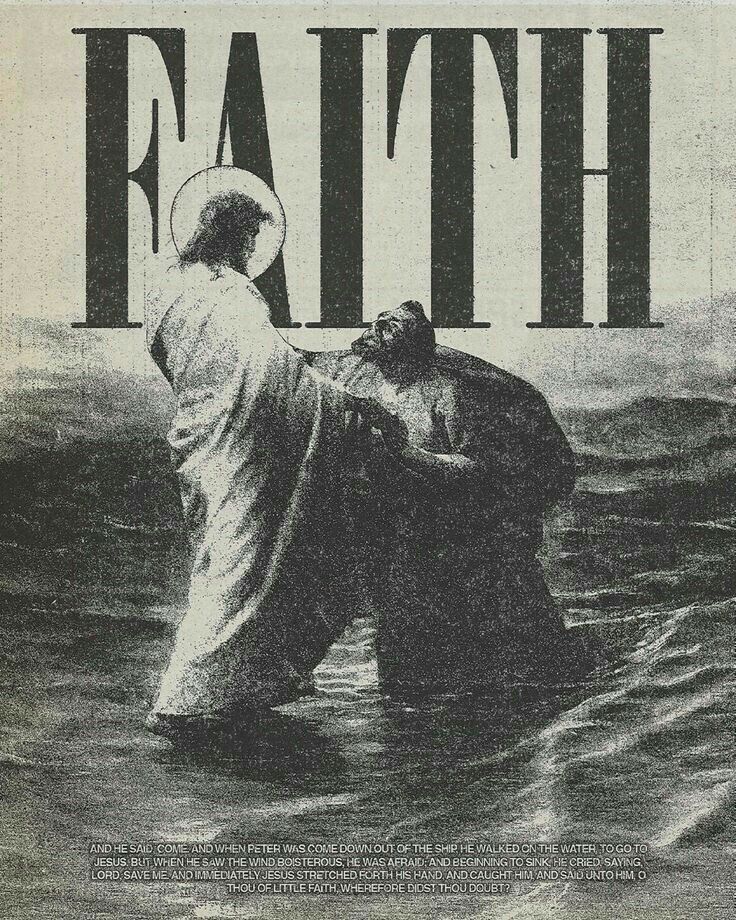
Jesus’s most powerful moments in the Gospels are not always his miracles. They are sometimes simply his presence. When the disciples are terrified on a storm-tossed sea, he comes to them walking on the water and says, simply: ‘It is I. Do not be afraid.’ Not a theological lecture. Not a solution to the storm (though that comes). Just: I am here.
This is the core of what believers are claiming when they say ‘Jesus is all we have.’ Not that Jesus provides a neat resolution to every crisis. Not that faith immunizes against suffering. But that in the worst moments of human experience — when every other support has failed, when the night is at its darkest — there is a Presence that does not leave, that is not surprised, and that has, in the most literal sense, been there.
Conclusion: The Weight and the Wonder of a Name
We have traveled, in these pages, through theology and history, philosophy and emotion, community and eschatology. We have tried to take seriously both the audacity and the vulnerability of the claim that Jesus is all we have. We have not resolved every tension. We have not answered every objection. To do so would be to diminish the reality we are describing, which is not a solved equation but a living relationship.
What we can say, with confidence drawn from two thousand years of testimony, is this: the claim is not small. It is not cowardly. It is not the refuge of those too weak or too simple to engage the world on its own terms. It is, in fact, the most demanding and most glorious claim a human being can stake. To say ‘Jesus is all we have’ is to say that you have found, in one person, the answer to the questions you didn’t know you were asking. The bread when you were starving. The light when you were lost. The shepherd when you were scattered. The resurrection when death seemed
final.
It is to say that you have tasted something that made everything else taste different. Not nothing — but different. Rightly ordered. Properly placed. Relativized by a joy and a love so vast that they make everything else look, at last, exactly what it is: temporary gift, not eternal ground.
The phrase ‘Jesus is all we have’ will always sound like poverty to those who have not discovered its wealth. It will always sound like narrowness to those who have not experienced its infinite interior. But to those who have — who have come to the end of themselves and found not emptiness but Person, not silence but Presence, not absence but the quiet, unassailable I AM — it sounds like the most liberating sentence in the universe.
Jesus is all we have. And He is enough.
“For from him and through him and to him are all things. To him be the glory forever. Amen.”
— Romans 11:36
Author : Oluwatosin Esomojumi Collins